What was discovered on the inside of the temples? Post an example of the inside wall(s) of an Ancient Egyptian temple.carved and painted images on every wall and surface
Scholars believe that Ancient Egyptians were inspired and influenced by which written language?cuneiform; concept of expressing words in writing
What is the difference between logographic and alphabetic elements?logograpchic was stylized and simplified where as alphabetic evovled later into demotic (document writing)
The term Hieroglyphic derived from what two Greek words?hiero - sacred
glyphic - engraving or writing
What is a scribe? a person who could read and write, could go to scribe school; priests
Who else was trained to read and write? Why?military leaders so they could communicate while in battle
What is a substrate?
What were the Books of the Dead?book of instuctions and spells to help them find their way to the afterlife
How did Ancient Egyptian hieroglyphics become a forgotten language?all non-christian temples were closed and all who could read and write the hieroglyphics dispeared until no one knew how to decipher the language
What three languages are included on the stone?
Egyption Hieroglyphics, Demotic, and Greek
Why couldn't the text on the Stone be deciphered?a chunk of the stone was missing
Who finally deciphered the text? What was his breakthrough?Jean Francois Champollion; when he was able to match up the hieroglyphic symbols with the greek versionof the name Egyptian Pharoah Ramses
Why does the interpretation of the Rosetta Stone have such significance?we know a great deal about the ancient Egyptians and Egyptian Hieroglyphics
Post an example of the Rosetta Stone.
What is the Rosetta Stone? Where was it discovered?a stone with translations of the same text; Napolean Bonepart
What is papyrus and how was it made?substrate made from reeds native to Egypt; the wet reeds are placed criss-cross over each other, flattened and dried, then rubbeed with stones to be flattened
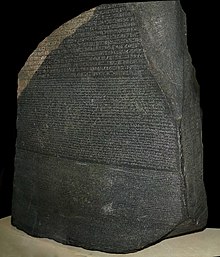 |
| Rosetta Stone |
 Hieroglyphics on papyrus  |
| Inside ancient Egyptian temple walls |

No comments:
Post a Comment